Four finalists announced for a permanent work at the new MAC
Canada NewsWire
MONTREAL, July 9, 2026
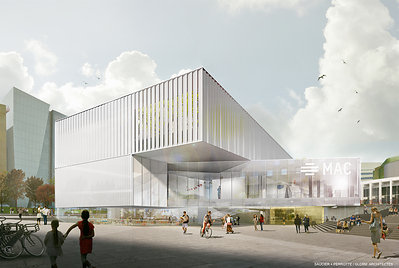
MONTREAL, July 9, 2026 /CNW/ - The Musée d'art contemporain de Montréal (MAC), in collaboration with the ministère de la Culture et des Communications and the Société de la Place des Arts de Montréal, is very pleased to announce the finalists in the province-wide competition for the integration of art into architecture and the environment. The competition was launched in the spring of 2026 for the creation of a permanent work at the new Museum in Montreal's Quartier des spectacles.
From among the 30 or so eligible applications received, the selection committee has chosen artists Ludovic Boney, Rafael Lozano-Hemmer and Sandra Volny, as well as the collective comprising Steve Bates, Alexandre Burton and Marc-Alexandre Reinhardt. These artists stand out for the originality, diversity and richness of their practice in digital and sound art, which is in harmony with the vision presented in the call for entries.
The province-wide competition was created in the context of the policy on the integration of the arts into the architecture and environment of government and public buildings and sites in Quebec (Politique d'intégration des arts à l'architecture et à l'environnement des bâtiments et des sites gouvernementaux et publics du Québec). The competition aims to commission a permanent work of digital art – specifically sound art, with or without a visual component – to be integrated into the public spaces of the new MAC following its major architectural transformation. The commission highlights the richness of sound art and opens up new perspectives for public art, moving beyond the material and monumental approaches traditionally associated with this type of installation.
The finalists will develop their proposals and present them to the selection committee in October. The winner will be announced this fall and the work will be installed for the opening of the new Museum in 2028.
QUOTES
"The MAC has always been a place that encourages boldness. These finalists demonstrate the vitality and originality of digital art creation in Quebec. We look forward to discovering a unique and enduring voice that will enrich our new Museum this fall.
- Stéphan La Roche, Director, Musée d'art contemporain de Montréal
OFFICIAL BIOGRAPHIES OF THE FINALISTES
Ludovic Boney
Ludovic Boney is from Wendake, Quebec. He works on large-scale public art projects and regularly exhibits his work in galleries and artist-run centres. More recently, his work has shifted toward sound and immersive sculptures. By inviting viewers to participate in his sculptural installations, he creates works in which the spectator becomes an integral part of the composition. His practice, which is formalistic by nature, embodies a discourse rooted in his Indigenous culture. As a multicultural artist from a hybrid cultural background, he brings together cultural tradition with contemporary aesthetics and, in so doing, actively participates in the conciliation of Canadian and Indigenous cultures. Boney recently exhibited works at the Montreal Museum of Fine Arts as well as at Nuit Blanche Toronto. Notable public art works include In Equilibrium, installed at the Anishnawbe Indigenous Hub in Toronto; Théâtralité contextuelle at the new HEC Montréal; the monumental Cosmologie sans genèse au Musée national des beaux-arts du Québec, and Ahchiouta'ah, a digital and sound work currently exhibited at the Grand Théâtre de Québec. Boney's works are included in numerous public and private collections.
Rafael Lozano-Hemmer
Rafael Lozano-Hemmer, a Canadian artist from Mexico, creates platforms for public participation using robotic lights, digital fountains, computerized surveillance and telematics networks, among other tools. Inspired by phantasmagoria, carnival and animatronics, his interactive works are anti-monuments that allow people to self-represent. Lozan-Hemmer was the first artist to represent Mexico at the Venice Biennale in 2007, and his works are part of the collections of the MAC, MOMA, the Guggenheim, the Tate, the Reina Sofía and Hirshhorn, among others. Recent exhibitions include Unstable Presence, Common Measures, Translation Island and Unfinished Garden, a major solo exhibition at the Museo De Arte Moderno in Mexico City.
Sandra Volny
Sandra Volny explores the sensory dimensions of listening as a medium for knowledge, memory and our relationship to the world. At the intersection of art, scientific research and fieldwork, her work focuses on imperceptible vibrations and fragile environments. She completed her PhD in Art Sciences and Aesthetics at the University of Paris1 Panthéon-Sorbonne and is interested in the survival of sound spaces and the many ways in which sound persists through matter, bodies and environments. Her work has been presented at several institutions and art centres, including the PHI Foundation, the Fonderie Darling, the Musée d'art de Joliette, the Ars Electronica Center in Linz and, more recently, at the Yvonne L. Bombardier Centre and the Goethe-Institute Paris. Volny's works are included in public and private collections, including those of the Musée d'art contemporain de Montréal, Hydro-Québec, Desjardins Bank, the City of Laval and Majudia.
Steve Bates, Alexandre Burton and Marc-Alexandre Reinhardt (collective)
Steve Bates
Steve Bates is an artist and musician based in Montreal. Sound is at the core of his practice and it manifests through music, transmission, video, sound art and installation. He has exhibited and performed in Canada, the United States, Europe, Chile and Senegal. His work is released through his music and publishing project, The Dim Coast. Bates works in the field, on the airwaves and in museum, gallery and performance settings. These shifting territories also reflect the themes explored in his practice.
Alexandre Burton
As an artist and digital luthier, Alexandre Burton explores technology to reveal its unique sensibility. His approach focuses primarily on connecting sound, visual and somatic phenomena, which he orchestrates into devices in which the machine merges with sensory experience. His work is regularly presented at international digital art and electronic music events. A founding member of artificiel.org, Burton also collaborates with numerous artistic and cultural organizations as an architect of generative sound and visual processes, as well as a consultant in technology integration. His work combines technical rigour and formal research into a distinctive digital poetics.
Marc-Alexandre Reinhardt
Trained in comparative literature, Marc A. Reinhardt has developed a practice at the intersection of writing, installation and performance, using sound primarily as a poetic, speculative and sculptural medium. He has presented works in Quebec, Europe and South America. He lives in Gatineau, where he runs Le Clinique, a small experimental publishing house. He is currently guest curator at the DAÏMÔN centre and teaches at the 'École des Arts et des Cultures (ÉdAC).
COMPETITION OVERVIEW
The Quebec policy on the integration of the arts into the architecture and environment supports citizen engagement with contemporary art and promotes the visibility of Quebec artists. It aims to introduce Quebeckers to all forms of contemporary art, to support contemporary art in architecture and public spaces and to enrich the quality of life of citizens.
Since 1961, the Politique d'intégration des arts à l'architecture et à l'environnement des bâtiments et des sites gouvernementaux et publics has contributed to the rise in public art through works integrated into Quebec's public buildings. Nearly 4500 works of art have been integrated into public buildings and sites across 17 administrative regions.
The call for entries for the province-wide competition, launched by the ministère de la Culture et des Communications in collaboration with the Musée d'art contemporain de Montréal and the Société de la Place des Arts de Montréal, ran from March 11 to April 27, 2026. Of the 44 entries received during this time, 32 were deemed eligible. The selection committee, made up of representatives from the three organizing bodies and visual arts specialists, selected four finalists from the eligible entries. Each finalist will receive $12,000 (taxes included) to develop their proposal. In October 2026, the artists will present their proposals to the members of the selection committee, who will select the winning work. The winning artist will be announced in the fall of 2026. The total budget allocated for the final design, production and installation of the selected work is $359,540 (taxes included).
The work will be integrated into one of the indoor public spaces at the new MAC.
About the Musée d'art contemporain de Montréal (MAC).
For over 60 years, the Musée d'art contemporain de Montréal (MAC) has brought together Québec and international artists, their work, and diverse audiences, championing art as an essential part of life in Montréal and across Québec. While its home in the heart of the Quartier des spectacles is undergoing a major architectural transformation, the Museum is temporarily housed at Place Ville Marie, one of the city's most iconic landmarks.
As preparations intensify for the opening of the new MAC at Place des Arts, exhibitions at Place Ville Marie have come to an end. Instead, the space now hosts cohorts of Habiter le MAC, a one-of-a-kind support program for emerging artists from across Québec. During this transition, the Museum continues to offer a vibrant public program, including cultural and educational activities, creative workshops, artist talks, lectures, and special events.Learn more: macm.org/en
SOURCE Musée d'art contemporain de Montréal

